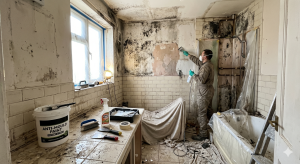
What Is Anti-Mould Paint?
Anti-mould paint is a type of interior coating designed to reduce the growth of mould and mildew on painted surfaces. It contains special additives that inhibit fungal development on walls and ceilings.
In simple terms, it:
- Creates a protective surface layer
- Reduces the ability of mould spores to grow on the paint film
- Helps slow down visible mould formation in damp environments
However, it is important to understand that it does not remove moisture and does not fix the underlying cause of dampness.
How Anti-Mould Paint Works
Anti-mould paint works by combining standard decorative paint with fungicidal agents. These agents are dispersed throughout the paint layer and act as a barrier against microbial growth.
The process can be summarised as follows:
- Mould spores land on the painted surface
- The protective additives in the paint disrupt their growth cycle
- Spores fail to develop into visible mould colonies
This makes the surface less suitable for mould to spread, particularly in areas exposed to humidity.
However, this protection only applies to the surface layer. If moisture continues to build up behind or around the paint, mould can still develop underneath or eventually reappear.
Do Anti-Mould Paints Actually Work?
The effectiveness of anti-mould paint depends heavily on the environment in which it is used.
They work well when:
- The room has good ventilation
- Humidity levels are controlled
- Surfaces are properly cleaned before application
- There is no structural damp present
They are less effective when:
- There is persistent condensation
- Rooms are poorly ventilated
- Moisture sources remain unresolved
- Cold walls encourage continuous water build-up
In practice, anti-mould paint should be seen as a preventative coating, not a cure for damp problems.
The Biggest Misconception About Anti-Mould Paint
A common misunderstanding is that painting over mould will permanently solve the issue.
In reality:
- Painting over active mould traps moisture underneath
- The mould often continues growing below the surface
- Stains may reappear through the paint over time
- The problem usually returns in the same area
For this reason, surface preparation is just as important as the paint itself.
Where Anti-Mould Paint Works Best
Anti-mould paint is most effective in areas where moisture is present but manageable.
Typical high-performance areas include:
- Bathrooms with regular steam exposure
- Kitchens with cooking humidity
- Bedrooms with external cold walls
- Hallways with limited airflow
- Utility spaces with washing and drying activity
These areas tend to experience condensation rather than structural damp, making them suitable for protective coatings.
Where Anti-Mould Paint Is Not Enough
There are situations where anti-mould paint alone will not solve the issue.
It is not suitable for:
- Rising damp from ground levels
- Water leaks from plumbing or roofing
- Severe insulation problems causing cold bridging
- Constant high humidity without ventilation
In these cases, moisture is continuously feeding the mould problem, and paint alone cannot stop it.
The Role of Condensation in Mould Growth
Condensation is the main trigger for mould in UK homes during winter.
It occurs when:
- Warm, moist indoor air meets cold surfaces
- Water droplets form on walls, ceilings, and windows
- Moisture accumulates over time
This creates ideal conditions for mould spores to grow.
Anti-mould paint does not stop condensation itself. It only reduces the ability of mould to develop on surfaces where condensation occurs.
Proper Application of Anti-Mould Paint
For best results, correct preparation is essential.
Step-by-step approach:
- Remove all visible mould using a suitable cleaning solution
- Ensure the surface is fully dry before painting
- Repair any cracks, flaking paint, or damaged plaster
- Improve ventilation in the room beforehand
- Apply the paint evenly in multiple coats
- Maintain airflow after application to prevent moisture build-up
Skipping preparation significantly reduces performance and lifespan.
How Long Does Anti-Mould Paint Last?
The durability of anti-mould paint depends on environmental conditions.
- In well-ventilated rooms: several years of protection
- In moderately damp areas: shorter lifespan
- In poorly ventilated spaces: rapid decline in effectiveness
Over time, the fungicidal additives weaken, especially in rooms with constant moisture exposure.
Regular ventilation and humidity control extend its effectiveness significantly.
Key Benefits of Anti-Mould Paint
- Reduces visible mould growth on painted surfaces
- Helps protect walls in high-humidity rooms
- Improves the appearance of previously affected areas
- Acts as a preventative barrier against spores
- Useful as part of a wider damp control strategy
Limitations You Need to Understand
- Does not remove moisture or condensation
- Cannot fix structural damp issues
- Requires proper surface preparation to be effective
- Performance depends heavily on ventilation quality
Anti-Mould Paint vs Moisture Control
One of the most important points to understand is that anti-mould paint is not a standalone solution.
Long-term mould prevention requires:
- Consistent ventilation (natural or mechanical)
- Controlled indoor humidity levels
- Proper heating to reduce cold surfaces
- Insulation improvements where necessary
Paint is only one layer in a wider moisture management system.
Common Mistakes Homeowners Make
Several mistakes reduce the effectiveness of anti-mould paint:
- Painting over damp or wet surfaces
- Ignoring ventilation problems
- Not addressing condensation sources
- Using paint as the only solution
- Failing to clean affected areas thoroughly
Avoiding these mistakes is critical for achieving lasting results.
When Anti-Mould Paint Is Worth Using
Anti-mould paint is most useful when:
- Mould is recurring on clean, dry surfaces
- The room suffers from mild to moderate condensation
- Ventilation improvements are already in place
- You are combining it with other moisture control methods
It is most effective as a protective finishing layer, not a repair solution.
Final Verdict: Does Anti-Mould Paint Really Work?
Anti-mould paint can be effective in reducing surface mould growth, particularly in moisture-prone rooms. However, its success depends entirely on the conditions in the home.
It works best as part of a broader approach that includes ventilation, heating control, and humidity management. Without these measures, mould will likely return regardless of the paint used.
In summary, anti-mould paint is a useful tool, but it is not a cure. Long-term success depends on controlling the environment that allows mould to form in the first place.